
Mean
If you’ve recently undergone IVF and received your embryology report, chances are your eyes immediately went to combinations like 4AA, 3BB, or 8-cell Grade A. One of the first questions I hear during consultations is, “Doctor, is my embryo good?” or “Does this grade mean my IVF will definitely work?”
I completely understand why. After weeks of medications, scans, egg retrieval, and anxious waiting, these letters and numbers suddenly seem to hold your entire future. Over the years, I’ve learned that embryo grades can be both reassuring and confusing. Many patients spend hours searching online before meeting me, often assuming that only an AA embryo can become a healthy baby. By the time they come into my clinic, they’re already worried about embryos with a BB or BC grade.

Free Thursday Consultation
Book Your AppointmentThis is exactly why I wanted to write this guide. Embryo grading explained in simple language can help you understand what your report is actually telling you and, just as importantly, what it isn’t.
What Embryo Grading Can and Can’t Tell You
Embryo grading is a way for embryologists to describe how an embryo looks under the microscope.
Think of it as a visual assessment. The grading system evaluates the embryo’s appearance, structure, and stage of development. It helps embryologists select the embryo that appears most likely to implant successfully.
However, embryo grading does not tell us:
- Whether the embryo is genetically normal
- Whether implantation will definitely happen
- Whether the pregnancy will continue to term
In other words, embryo grading gives us valuable information, but it is only one piece of the IVF puzzle. I often remind my patients that an embryo is much more than a set of letters.
Day 3 Embryo Grading: What Happens at the Cleavage Stage?
Some IVF cycles involve transferring or freezing embryos on Day 3, also called the cleavage stage. At this point, embryologists mainly look at three features:
1. Cell Number
A healthy Day 3 embryo usually has around 6–10 cells, with 8 cells often considered ideal. Embryos that divide too slowly or too quickly may have a lower chance of implantation, although this is not an absolute rule.
2. Cell Symmetry
Ideally, the cells should be approximately the same size. Uniform cells suggest healthy development, while uneven cell sizes may indicate less optimal growth.
3. Fragmentation
Sometimes tiny fragments of cellular material appear between the cells. A small amount of fragmentation is common and usually isn’t concerning. Higher levels of fragmentation can reduce the embryo’s developmental potential because they may interfere with normal cell communication.
When I review a Day 3 report with my patients, I explain that we’re looking at the embryo’s progress at one specific moment. Many embryos continue developing well despite not appearing “perfect” on Day 3.
Day 5 Blastocyst Grading: Understanding the 4AA and 3BB System
Most IVF laboratories today prefer to grow embryos until Day 5, when they reach the blastocyst stage. This is where grading becomes a little more detailed.
A blastocyst grade usually consists of:
- A number (1-6)
- The first letter (Inner Cell Mass)
- The second letter (Trophectoderm)
For example:
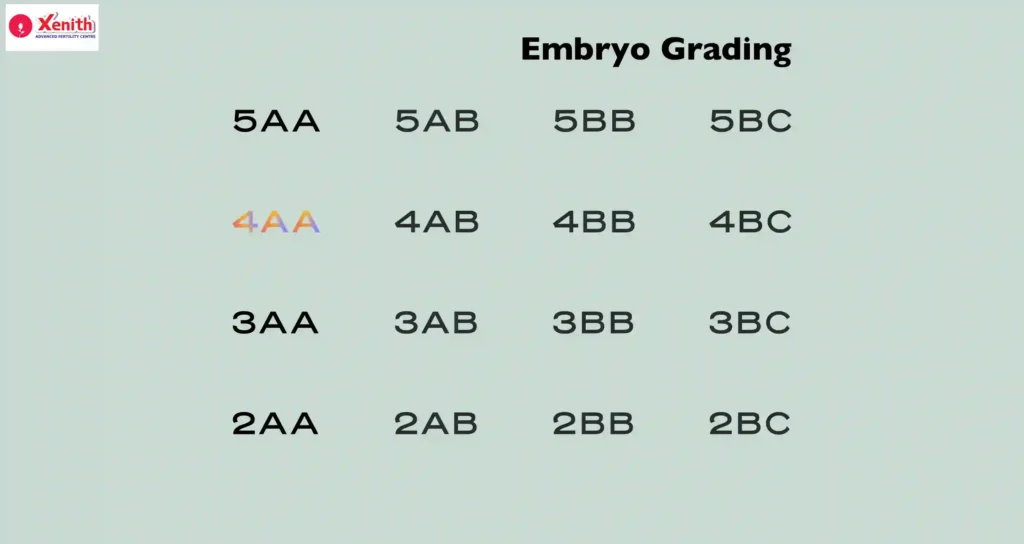
4AA
Let’s break it down.
| Grade Component | What It Means |
| Number (1-6) | How expanded or developed the blastocyst is |
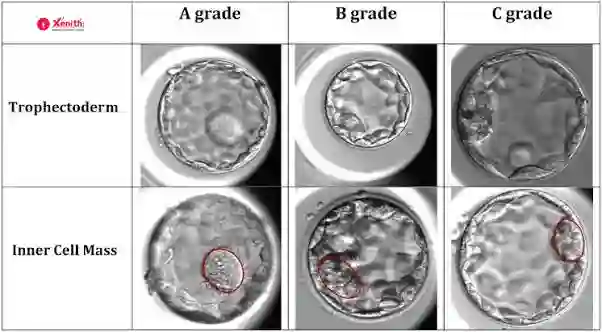
| First Letter | Quality of the Inner Cell Mass (ICM), which develops into the baby |
| Second Letter | Quality of the Trophectoderm (TE), which forms the placenta |
The Number (Blastocyst Expansion)
The number describes how much the embryo has expanded.
- 1–2: Early blastocyst
- 3: Full blastocyst
- 4: Expanded blastocyst
- 5: Hatching blastocyst
- 6: Fully hatched blastocyst
As embryos mature, they naturally move through these stages.
The First Letter: Inner Cell Mass (ICM)
The Inner Cell Mass eventually develops into the baby.
- A: Many tightly packed cells
- B: Slightly fewer or loosely arranged cells
- C: Fewer cells with less organized appearance
The Second Letter: Trophectoderm (TE)
The Trophectoderm develops into the placenta and supporting tissues.
- A: Numerous healthy-looking cells
- B: Moderate number of cells
- C: Fewer cells with a less organized structure
What Do Grades Like AA, AB, or BB Mean?
Here is a simple grading key that many patients find useful.
| Grade | General Interpretation |
| AA | Excellent appearance of both ICM and TE |
| AB | Excellent ICM with good TE |
| BA | Good TE with excellent ICM |
| BB | Good overall quality |
| BC / CB | Fair appearance in one component |
| CC | Lower morphological quality |
Is a Lower-Grade Embryo Still Worth Transferring?
Absolutely!
This is one of the biggest misconceptions surrounding IVF embryo grades meaning. I’ve celebrated successful pregnancies from embryos that many patients initially felt disappointed about.
A BB embryo, for example, can still implant successfully and result in the birth of a healthy baby. Why? Because embryo grading evaluates morphology, meaning how the embryo looks, not its chromosomes, DNA, or ultimate developmental potential.
I’ve seen beautifully graded embryos fail to implant, and I’ve also seen average-looking embryos surprise everyone. This is why I never encourage patients to lose hope based solely on the letters in their report.
How Does Embryo Grading Relate to PGT-A?
Another common question I receive is whether a beautifully graded embryo is automatically genetically normal.
The answer is no.
A perfect-looking embryo can still have chromosomal abnormalities. Similarly, an average-looking embryo may be genetically normal. This is where PGT-A (Preimplantation Genetic Testing for Aneuploidy) provides additional information.
While embryo grading evaluates appearance, PGT-A assesses the chromosome number within the embryo. These two assessments complement each other rather than replace one another.
Why Can Embryo Grades Differ Between IVF Laboratories?
Patients are sometimes surprised when they compare reports from different fertility centres. The truth is that embryo grading isn’t completely identical across all laboratories.
Although internationally accepted grading systems exist, there can be slight differences in:
- Individual embryologist interpretation
- Timing of embryo assessment
- Laboratory protocols
- Culture media and incubation techniques
- Documentation methods
This doesn’t necessarily mean one laboratory is correct and another is wrong. Embryology involves both standardized criteria and experienced professional judgement. That’s why I always advise patients not to compare embryo grades from different clinics without understanding the context.
What Our Embryology Team at Xenith Looks

Beyond the Letter Grade
At Xenith, embryo grading is only one part of the evaluation process. Our embryology team also carefully observes:
- The embryo’s rate of development
- Cell division patterns
- Developmental milestones
- Overall growth behaviour during culture
- Clinical history of the patient
- Previous IVF outcomes, when applicable
When selecting an embryo for transfer, we don’t simply choose the highest letters on the report. Instead, we consider the complete clinical picture.
Final Thoughts
Receiving your embryology report can feel overwhelming, especially when you’re trying to interpret unfamiliar letters and numbers.
My advice is simple: don’t let embryo grades become the sole measure of hope. They are useful tools that help us make informed decisions, but they are only one part of your fertility journey.
At your next consultation, bring your embryology report with you. I always encourage my patients to ask questions, no matter how small they seem. Understanding your report often replaces anxiety with clarity, and that’s an important step in moving forward with confidence.
Every IVF journey is unique, and every embryo has its own story. Together, we’ll interpret your report in the context of your overall treatment, so you have a clear understanding of what your embryo grades mean for your journey, not someone else’s.