
When I tell a patient that I’d like to perform a mock embryo transfer before her embryo transfer cycle, I often see a puzzled expression. One of the first questions I hear is, “Doctor, does this mean something is wrong?” Others ask, “Will you be transferring the embryo that day?”
The answer is no.

Free Thursday Consultation
Book Your AppointmentA mock embryo transfer is not another treatment cycle, and it does not involve placing an embryo into the uterus. Instead, it is simply a practice run that allows us to prepare for one of the most important steps in the IVF journey.
Over the years, I’ve found that patients feel much more relaxed once they understand why this procedure is done. Rather than being an extra hurdle, it is often a way to make the actual embryo transfer as smooth and precise as possible.
In this article, I’ll explain what a mock embryo transfer is, why your fertility specialist may recommend one, and what you can expect during the procedure.
What Is a Mock Embryo Transfer?
A mock embryo transfer, also called a trial transfer IVF, is exactly what the name suggests, a rehearsal for the actual embryo transfer.
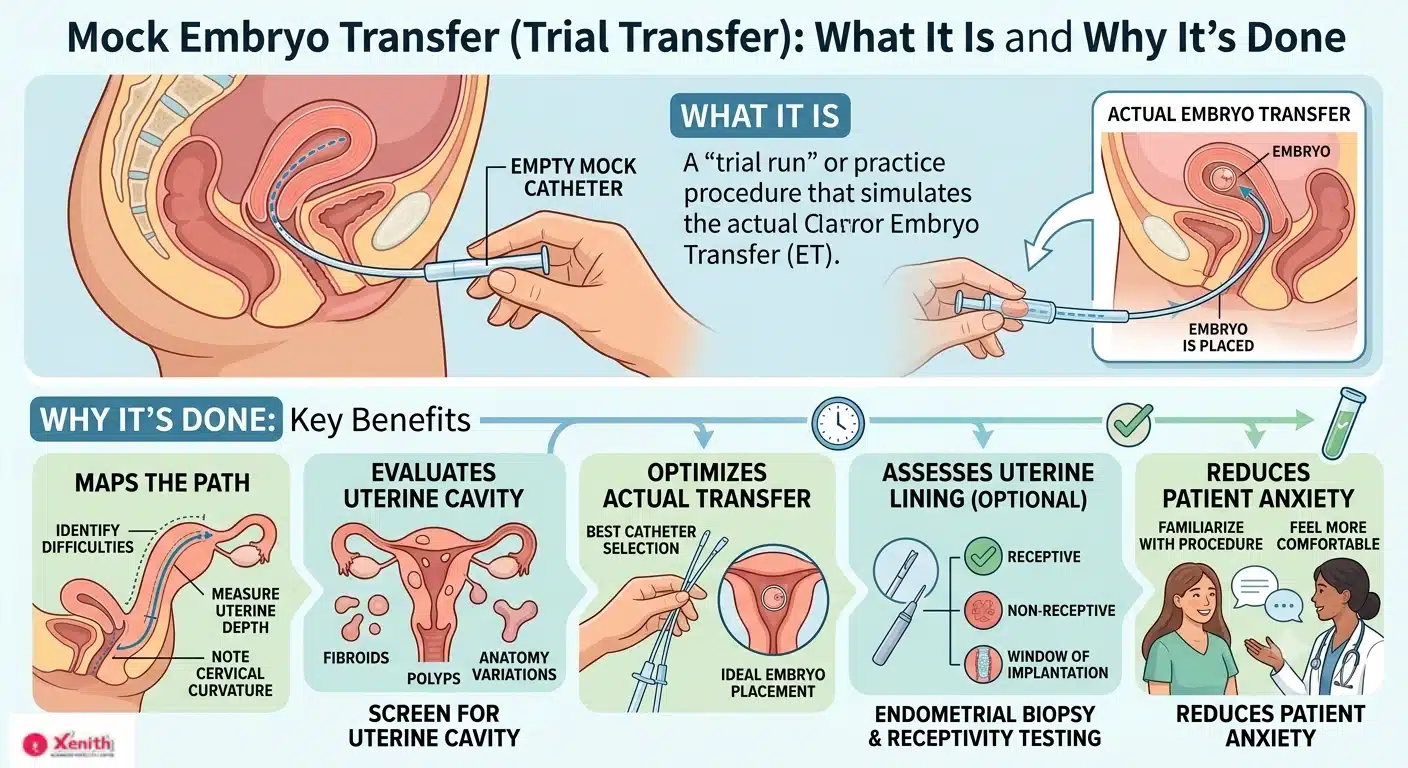
During the procedure, your doctor gently passes an empty transfer catheter through the cervix and into the uterus. No embryo is loaded into the catheter. No fertilization or transfer takes place. The purpose is simply to understand the anatomy of your uterus and cervix before the day of the real embryo transfer.
I often explain it to my patients using a simple comparison. If you were planning an important journey, you might check the route beforehand to avoid unexpected delays. A mock transfer serves a similar purpose. It allows us to familiarise ourselves with the path before carrying the embryo.
Why Is a Mock Embryo Transfer Done?
Although embryo transfer appears to be a simple procedure, it requires careful precision. The catheter carrying the embryo must pass gently through the cervical canal and reach the ideal location within the uterine cavity. For many women, this is straightforward.
However, in some cases, the anatomy of the cervix or uterus may make catheter placement slightly more challenging. A mock transfer helps us identify these details in advance.
During the procedure, we can:
- Map the uterine cavity
- Assess the shape and direction of the cervical canal
- Identify any areas where catheter passage may be difficult
- Measure the appropriate depth for embryo placement
Having this information beforehand often allows the actual embryo transfer to proceed more efficiently and with fewer surprises. I always remind patients that we want the transfer day to be calm and unhurried. The more information we have in advance, the more confidently we can perform the procedure.
When Is a Mock Transfer Usually Performed?
Patients often ask me whether the mock transfer happens on the same day as embryo transfer. Usually, it does not.
A mock transfer before FET (Frozen Embryo Transfer) is commonly performed in advance of the treatment cycle or during the preparation phase, depending on the clinic’s protocol and the patient’s individual circumstances. Planning it ahead of time allows us to gather the necessary information without adding extra steps on the day the embryo is transferred.
Some patients also come across the term what is a mock cycle IVF while searching online. Although the terms sound similar, a mock embryo transfer specifically refers to this practice procedure involving the transfer catheter. It is different from other types of mock cycles that may be used for different aspects of fertility treatment.
Your fertility specialist will explain exactly which type of preparation is appropriate in your case.
What Does the Procedure Feel Like?
One of the biggest concerns patients have is whether the procedure will be painful. Fortunately, most women describe it as causing only mild discomfort. I usually tell my patients to expect a sensation similar to having a routine pelvic examination or a Pap smear.
You’ll lie comfortably on the examination table while a speculum is inserted to visualize the cervix. The catheter is then gently passed through the cervical canal into the uterus. The entire procedure usually takes only a few minutes.
Some women experience mild cramping while the catheter is being positioned, but this generally settles quickly once the procedure is complete. Most patients are able to return to their normal daily activities immediately afterwards.
What Does Your Doctor Learn from a Mock Transfer?
Although the procedure itself is brief, it provides valuable information that helps us prepare for the real embryo transfer.
A mock transfer allows us to determine:
- The most suitable catheter for your anatomy
- The easiest path through the cervical canal
- The depth at which the embryo should be placed within the uterus
- Whether any additional guidance or adjustments may be helpful during the actual procedure
This preparation helps reduce unnecessary manipulation on embryo transfer day. Instead of spending valuable time determining the best approach while the embryo is already loaded into the catheter, much of that planning has already been completed.
In my experience, careful preparation contributes to a smoother transfer experience for both the patient and the clinical team.
Does Everyone Need a Mock Embryo Transfer?
The simple answer is no. A mock embryo transfer is not routinely necessary for every patient undergoing IVF. For many women, previous examinations and imaging provide enough information to allow embryo transfer without a separate practice procedure.
However, there are situations in which a mock transfer may be particularly helpful.
For example, your fertility specialist may recommend one if:
- There has been a previously difficult embryo transfer.
- The cervical canal appears challenging on examination.
- There are anatomical variations that may affect catheter passage.
- Additional planning is expected to make the transfer smoother.
The decision is always individualized. Whenever I recommend a mock transfer, it is because I believe the information gained may help us perform the actual embryo transfer with greater confidence and precision. Rather than viewing it as an unnecessary extra procedure, I encourage patients to see it as part of careful treatment planning.

Final Thoughts
A mock embryo transfer is a simple practice procedure performed before the actual embryo transfer. No embryo is involved. Instead, it allows your fertility specialist to map the uterine cavity, understand the cervical canal, and plan the safest and most efficient approach for transfer day.
Although not every patient requires a trial transfer IVF, it can be especially valuable when there is a possibility of a technically difficult transfer or when additional planning is expected to improve the procedure.
Most women find that the procedure is quick, involves only mild discomfort, and provides reassurance that everything has been carefully planned before the embryo transfer itself.
If your doctor has recommended an embryo transfer practice run, don’t hesitate to ask questions during your consultation. We’ll explain why it’s being advised in your individual case, what will happen during the procedure, and how the information we gather may help make your embryo transfer as smooth and well-prepared as possible.