One of the most difficult conversations I have in my clinic is with a young woman in her twenties or thirties who has just been told that her ovaries are not functioning as expected. Many arrive believing they simply have irregular periods or a hormonal imbalance. Instead, they leave with a diagnosis of premature ovarian insufficiency.
I still remember a patient in her early thirties who looked at me quietly after we discussed her reports and asked, “Doctor, does this mean I’ll never become a mother?” It wasn’t just a medical question, it came from fear, uncertainty, and grief. Before we discussed treatment options, we first spoke about what the diagnosis actually meant.

Free Thursday Consultation
Book Your AppointmentIf you’ve recently been diagnosed with premature ovarian insufficiency, I want you to know that understanding the condition is the first step. While POI certainly affects fertility, it is not the same as natural menopause, and it does not always mean pregnancy is impossible.
In this article, I’ll explain what POI is, how it is diagnosed, what causes it, and what fertility options may still be available.
What Is Premature Ovarian Insufficiency?
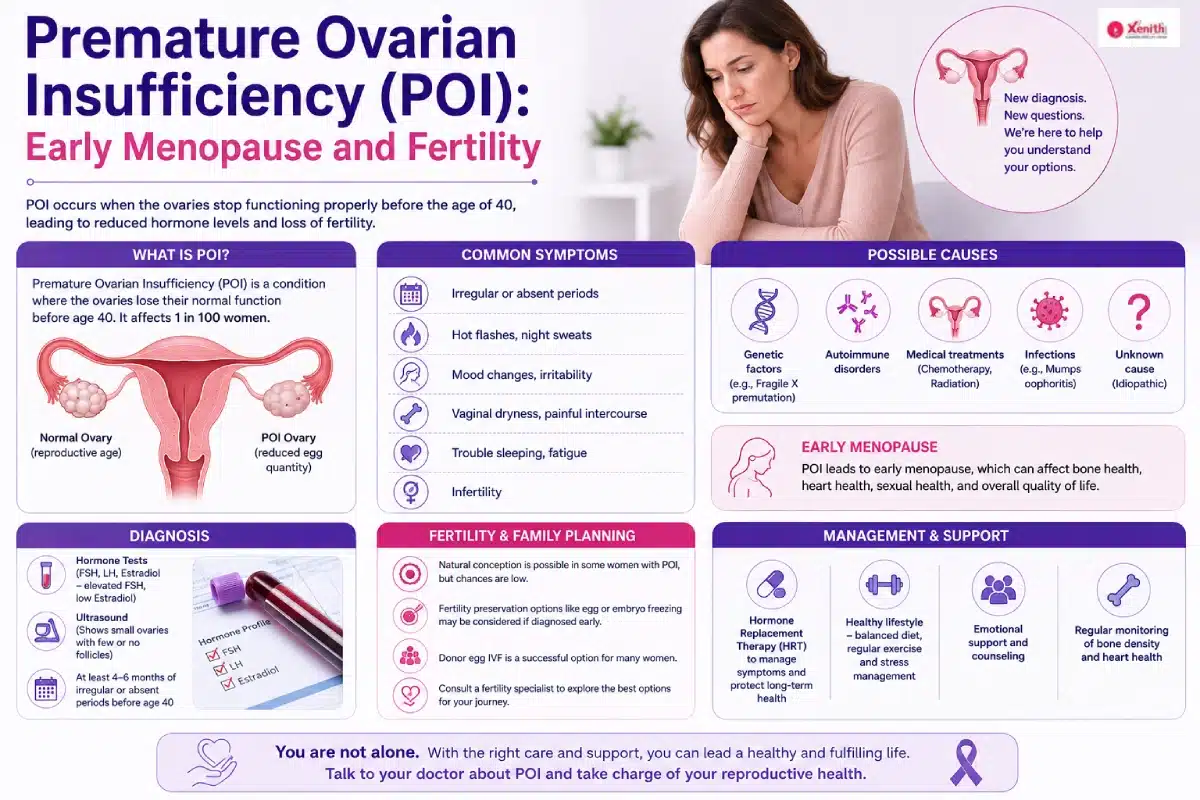
Premature ovarian insufficiency (POI) is a condition in which the ovaries lose their normal function before the age of 40.
Normally, the ovaries release eggs regularly and produce important hormones such as estrogen. In women with POI, ovarian function becomes significantly reduced much earlier than expected. Many people mistakenly refer to POI as “early menopause,” but medically, the two conditions are not exactly the same.
In natural menopause, ovarian function stops permanently, and periods do not return. In POI, however, ovarian activity can be unpredictable. Some women may still ovulate occasionally, hormone levels may fluctuate, and spontaneous menstrual cycles can sometimes occur even after the diagnosis.
Another important distinction is the difference between POI vs low AMH.
Low AMH simply indicates a reduced ovarian reserve, it tells us that the number of remaining eggs is lower than expected. Many women with low AMH continue to have regular menstrual cycles and may conceive naturally. POI, on the other hand, involves impaired ovarian function along with hormonal changes and irregular or absent ovulation. While AMH is often low in POI, the diagnosis depends on much more than a single blood test.
What Symptoms Lead to a Diagnosis?
The symptoms of POI often begin gradually, which is why the diagnosis can sometimes be delayed. One of the earliest signs is a change in menstrual cycles.
Some women notice that their periods become irregular, while others stop menstruating altogether for several months.
Other POI symptoms may include:
- Irregular or absent periods before the age of 40
- Hot flashes
- Night sweats
- Vaginal dryness
- Mood changes
- Difficulty sleeping
- Reduced libido
These symptoms resemble those experienced during menopause because estrogen production declines. However, when they occur in younger women, they deserve careful medical evaluation. I always encourage women not to ignore persistent menstrual changes simply because they’re busy or under stress. While stress can certainly affect periods, repeated missed cycles should always be investigated rather than assumed to be temporary.
How Is Premature Ovarian Insufficiency Diagnosed?
Diagnosing POI requires a combination of symptoms, medical history, and laboratory testing. Several investigations help us understand how the ovaries are functioning.
Follicle Stimulating Hormone (FSH)
FSH is produced by the pituitary gland to stimulate the ovaries. When the ovaries are no longer responding effectively, the brain produces more FSH in an attempt to stimulate them. Persistently elevated FSH levels are one of the key findings in premature ovarian insufficiency.
Estradiol
Estradiol is one of the main forms of estrogen produced by the ovaries. Women with POI often have lower estradiol levels because ovarian hormone production has declined.
Anti-Müllerian Hormone (AMH)
AMH reflects ovarian reserve. Although AMH is frequently low in women with POI, it is only one part of the overall assessment and should never be interpreted on its own.
Genetic Testing
In some women, especially those diagnosed at a young age or with a family history, genetic evaluation may be recommended. This can include karyotype analysis to identify chromosomal abnormalities and testing for certain inherited conditions such as the Fragile X premutation, which has been associated with premature ovarian insufficiency. Not every woman requires genetic testing, but it can provide valuable information in selected cases.
What Causes Premature Ovarian Insufficiency?
One of the first questions patients ask me is, “Why did this happen?” Unfortunately, there isn’t always a clear answer. Several factors have been associated with POI.
Autoimmune Conditions
In some women, the body’s immune system mistakenly attacks ovarian tissue, affecting ovarian function over time.
Genetic Causes
Certain genetic conditions increase the risk of premature ovarian insufficiency. One of the best-known examples is the Fragile X premutation, although other chromosomal abnormalities may also play a role.
Medical Treatments
Some cancer treatments, particularly chemotherapy and pelvic radiation, can damage ovarian tissue. Similarly, certain ovarian surgeries may reduce the amount of functioning ovarian tissue that remains. These are referred to as iatrogenic causes because they result from medical treatment.
Idiopathic POI
Despite thorough evaluation, many women never receive a definite explanation. This is called idiopathic premature ovarian insufficiency, meaning the exact cause remains unknown. Although not having an answer can be frustrating, it is a common situation, and it does not change the importance of planning appropriate treatment and fertility care.
Can You Get Pregnant with POI?
One of the most common searches I see patients making before they meet me is: “Can you get pregnant with POI?”
The answer is more hopeful than many people expect, but it also requires realistic expectations. Because ovarian function in POI can occasionally fluctuate, spontaneous ovulation is still possible. This means that natural pregnancy can occur, although it is uncommon. A small percentage of women with POI do conceive naturally after diagnosis. However, because ovulation is unpredictable, it is difficult to rely on spontaneous conception when planning a family.
If POI is identified early and some ovarian function remains, fertility preservation may be discussed in carefully selected situations. Depending on the individual circumstances, this may include collecting and freezing eggs or embryos while ovarian activity is still present. Unfortunately, many women are diagnosed only after ovarian function has declined significantly, making these options less feasible.
For women with established POI and very limited ovarian reserve, donor egg IVF offers the highest chance of achieving pregnancy and remains the most realistic fertility treatment in most cases. Whenever I discuss donor egg IVF, I understand that it can be an emotional topic. Every patient needs time to process the information, ask questions, and decide what feels right for her family. There is no single “correct” decision, only the decision that aligns with each woman’s personal circumstances and goals.
The Emotional Impact of an Early Diagnosis
Receiving a diagnosis of ovarian failure before 40 is about much more than interpreting blood test results. Many women describe feeling shocked, confused, or overwhelmed. Some worry about future fertility, while others struggle with the unexpected idea of experiencing menopause-like symptoms at such a young age.
As a fertility specialist, I’ve learned that these emotions deserve just as much attention as the laboratory reports. During consultations, I encourage my patients to take their time. It’s completely normal to need space to absorb the diagnosis before making decisions about treatment or fertility planning. You do not have to understand everything in a single appointment, and you certainly do not have to make every decision immediately.
Final Thoughts
A diagnosis of premature ovarian insufficiency can feel overwhelming, especially when it comes unexpectedly during your reproductive years. However, it is important to remember that POI is not the same as natural menopause, and it does not automatically mean that every possibility for parenthood has disappeared.
The first step is understanding why your ovarian function has changed. From there, we can evaluate your hormone levels, discuss any additional investigations that may be appropriate, and create a fertility plan based on your individual situation.
Whether that involves monitoring remaining ovarian function, discussing fertility preservation, or exploring donor egg IVF, the goal is to help you make informed decisions with clarity rather than fear.
If you’ve been experiencing POI symptoms, have irregular or absent periods before the age of 40, or have recently been told you may have premature ovarian insufficiency, I encourage you to schedule a comprehensive hormonal evaluation and fertility planning consultation. Together, we can discuss your diagnosis, answer your questions, and identify the options that are most appropriate for your future.