AMH Levels Explained: What They Mean for Your Fertility
Introduction

Free Thursday Consultation
Book Your AppointmentWhen someone starts planning for pregnancy, one test that doctors often recommend is the AMH test. You might have heard friends or relatives say, “Check your AMH levels first.” But what exactly does it mean?
AMH is one of the most important indicators of fertility because it helps estimate your ovarian reserve, that is, the number of eggs you have. However, many people misunderstand it and assume it directly tells whether you can get pregnant or not.
The truth is a little different. Understanding AMH levels fertility connection can help you make better decisions about pregnancy, IVF, or even future planning. Let’s break it down in simple terms.
What Is AMH (Anti-Müllerian Hormone)?
AMH stands for Anti-Müllerian Hormone. It is a hormone produced by small follicles in the ovaries. These follicles contain immature eggs. So, the more follicles you have, the higher your AMH level tends to be.
In simple words:

| |
AMH = indicator of how many eggs are left in your ovaries
This is why AMH is commonly used as a marker for ovarian reserve AMH.
What Does the AMH Test Measure?
The AMH test meaning is quite straightforward: it measures the level of this hormone in your blood.
Here’s what it helps doctors understand:
- Your ovarian reserve (egg quantity)
- How your body may respond to fertility treatments
- Planning for IVF or egg freezing
But remember one important point: AMH does NOT measure egg quality
This is where many people get confused. You can have low AMH but still have good quality eggs.

AMH Levels: Normal Range Explained
Doctors usually interpret AMH levels in the following way:
AMH Level | Interpretation |
High (>4.0 ng/mL) | Possible PCOS |
Normal (1.0 – 4.0 ng/mL) | Healthy ovarian reserve |
Low (0.5 – 1.0 ng/mL) | Reduced reserve |
Very Low (<0.5 ng/mL) | Poor ovarian reserve |
(Values may slightly vary depending on the lab.)
If you are wondering what is good AMH level for pregnancy, generally a value between 1.0 and 4.0 ng/mL is considered reassuring. But pregnancy depends on many other factors too.
What Do Low AMH Levels Mean?
Hearing “low AMH” can feel scary, but it is not the end of the road.
Low AMH means:
- You have fewer eggs remaining
- Your ovarian reserve is reduced
- You may respond less to fertility medications
However, low AMH fertility chances are not zero. Many women with low AMH conceive naturally or with treatment. Egg quality and timing matter more than just numbers.
What Do High AMH Levels Mean?
High AMH levels are often linked to PCOS (Polycystic Ovary Syndrome).
This means:
- You may have a high number of eggs
- But ovulation may be irregular
So even though the egg count is high, getting pregnant may still be difficult without treatment.
Also, high AMH can increase the risk of ovarian hyperstimulation during IVF, so careful monitoring is required.
AMH and Age: What You Should Know
Age plays a very big role in fertility.
- AMH naturally declines as you grow older
- The decline becomes faster after age 35
- Egg quality also reduces with age
So even if your AMH is normal, age can still affect your chances of pregnancy. That’s why doctors often suggest checking AMH early if you are planning pregnancy later in life.
How AMH Levels Affect Fertility and IVF
AMH is especially useful when planning treatments like IVF.
Low AMH:
- Lower response to ovarian stimulation
- Fewer eggs may be retrieved
- IVF cycles may need adjustment
High AMH:
- Strong response to stimulation
- Risk of ovarian hyperstimulation syndrome (OHSS)
- Requires careful dosing of medicines
This is why AMH test for IVF is very important, it helps doctors personalize your treatment plan.
Can You Get Pregnant with Low AMH?
Yes, absolutely. Many women with low AMH conceive naturally or with minimal help.
Here’s why:
- Egg quality matters more than quantity
- Even one healthy egg can lead to pregnancy
- Proper guidance improves success chances
So, don’t lose hope if your AMH is low.
Diagnosis at Xenith IVF
At Xenith IVF, fertility evaluation is done in a complete and personalized way.
Diagnosis includes:
- AMH blood test
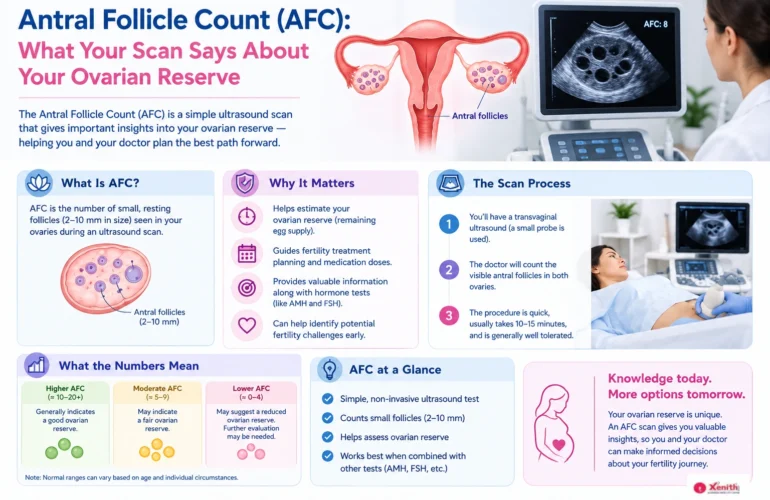
- Ultrasound scan (Antral Follicle Count)
- Hormonal profile
- Detailed medical history
This helps doctors understand your overall fertility picture, not just one number.
Can AMH Levels Be Improved?
This is a very common question.
The honest answer: AMH levels cannot be significantly increased
However, you can focus on improving egg quality by:
- Eating a balanced diet
- Regular exercise
- Managing stress
- Taking supplements (as prescribed)
So while the number may not change much, your fertility outcomes can still improve.
Treatment Options for Low AMH
Depending on your condition, doctors may suggest:
- Ovulation induction (to help release eggs)
- IVF / ICSI for better success chances
- Egg freezing if planning pregnancy later
- Donor egg options in advanced cases
Treatment is always customized based on age, AMH, and overall health.
When Should You Get an AMH Test?
You should consider testing if:
- You are planning pregnancy after 30
- You have difficulty conceiving
- You have irregular periods
- You are planning IVF
Early testing helps in better planning and avoids unnecessary delay.

Why Choose Xenith IVF
Choosing the right fertility center makes a big difference.
Xenith IVF offers:
- Advanced ovarian reserve testing
- Personalized treatment plans
- Experienced fertility specialists
- High success rates
Our approach focuses on both medical science and emotional support, which is very important during fertility treatment.
FAQs Section
- What is a good AMH level for pregnancy?
A level between 1.0–4.0 ng/mL is generally considered good, but pregnancy depends on age and egg quality too.
- Can low AMH lead to infertility?
Not always. Many women with low AMH still conceive naturally or with treatment.
- Can AMH levels improve over time?
AMH levels usually do not increase significantly, but lifestyle changes can support better fertility.
- Is IVF possible with low AMH?
Yes. IVF is often recommended in such cases, though protocols may be adjusted.
- What does high AMH indicate?
High AMH may indicate PCOS, where egg count is high but ovulation may be irregular.
Conclusion
AMH is an important tool to understand your fertility, but it is not the full story. It mainly tells you about egg quantity, not quality. Factors like age, lifestyle, and overall health also play a big role.
Instead of worrying about one number, focus on early testing, proper guidance, and the right treatment approach. If you are planning your fertility journey, don’t delay.
Book a consultation with Xenith IVF today and take the first step towards informed and confident fertility planning.