When you are going through IVF, every choice can feel significant and rightly so. One of the most common questions I hear from my patients at Xenith is: “Doctor, is there anything I can eat to help the treatment work?”
The honest answer is yes but to an extent. While no food can guarantee IVF success, I always remind my patients that good nutrition plays an important supporting role throughout fertility treatment. Research consistently shows that a well-nourished body responds better to fertility medications, supports egg quality, helps maintain a healthy uterine lining, and recovers more smoothly after procedures.

Free Thursday Consultation
Book Your AppointmentOver the years, I have also noticed that many fertility nutrition guides focus on foods that are not necessarily a part of our everyday Indian diets. That is why I wanted this guide to focus on foods that are practical, familiar, culturally relevant, and supported by evidence. My goal is to help you make informed choices using foods that are easily available and fit naturally into Indian households.
Please read this guide alongside the personalised advice I give you during your consultations, as every patient’s diagnosis, medical history, and treatment protocol are unique.
This guide is for general information. Always follow the specific dietary and supplementation advice given by your Xenith doctor, which is tailored to your individual diagnosis and protocol.
Why Does Diet Matter for IVF?
A question I am frequently asked is whether diet really influences IVF outcomes. While nutrition is not the only factor that affects treatment success, it does support several important aspects of reproductive health.
Egg Quality
One thing many patients are surprised to learn is that the eggs we retrieve have been developing for approximately 90 days before retrieval. This means that the nutritional choices you make in the months leading up to IVF can influence egg quality. Antioxidants, protein, and key micronutrients all play a role during this period.
Hormonal Balance
Healthy hormone function depends on many factors, including stable blood sugar levels, healthy fats, Vitamin D, zinc, and other micronutrients. These nutrients help support the hormonal environment needed for ovarian stimulation and implantation.
Uterine Lining
I often remind my patients that embryo quality is only one part of the equation. The uterine lining must also be receptive for implantation to occur. Adequate iron, folate, and Vitamin E support endometrial thickness and receptivity.
Inflammation Control
Low-grade inflammation can interfere with implantation, particularly in conditions such as PCOS and endometriosis. An anti-inflammatory eating pattern may help support overall reproductive health.
Medication Tolerance
Many fertility medications can cause fatigue, nausea, bloating, and digestive discomfort. In my experience, patients who maintain good nutrition and hydration often find it easier to manage these side effects.
Phase-by-Phase: What to Eat and When
Phase 1: Pre-Stimulation (3 Months Before Your IVF Cycle Starts)
If there is one phase where nutrition can have the greatest impact, it is this one. I often tell my patients to think of these three months as the foundation-building stage of their IVF journey.
| Food Group | Best Indian Sources |
| High-quality protein | Paneer, eggs, dal, rajma, chana, moong, curd, milk, chicken, fish |
| Antioxidant-rich foods | Amla, guava, tomatoes, spinach, methi, drumstick leaves (moringa), berries |
| Iron-rich foods | Palak, rajgira (amaranth), sesame seeds (til), dates, ragi, jaggery, liver |
| Folate sources | Moong sprouts, methi, spinach, broccoli, eggs — or a prescribed folic acid supplement |
| Healthy fats | Pure ghee (in moderation), coconut, groundnuts, flaxseeds, walnuts |
| Complex carbohydrates | Brown rice, jowar, bajra, ragi, oats — avoid refined maida products |
| Vitamin D | Morning sunlight + eggs, fatty fish, fortified milk; test levels and supplement if needed |
Phase 2: During Ovarian Stimulation
During stimulation, your ovaries are working hard and your body is adapting to significant hormonal changes. At this stage, the focus shifts from preparation to support.
I usually encourage my patients to focus on the following:
- High protein intake to support follicle development. Aim for 60–80g of protein per day
- Increased hydration. Drink 2.5 to 3 litres of water or diluted fluids daily to reduce OHSS risk
- Sodium balance. Avoid very salty processed foods; use rock salt or sendha namak if desired
- Easy-to-digest meals. Fertility medications can cause nausea and bloating, so lighter and more frequent meals are often better tolerated
- Coconut water is an excellent natural electrolyte drink during this phase
- Avoid alcohol entirely from this point forward
If you experience significant bloating during stimulation, I often suggest reducing raw vegetables and choosing lighter cooked meals instead. Dal khichdi, moong soup, and curd rice are excellent options that many patients find comforting and easy to digest.
Phase 3: After Embryo Transfer (The Two-Week Wait)
The two-week wait is often one of the most emotionally challenging parts of IVF. During this phase, many patients ask me whether they should dramatically change their diet.
My advice is usually simple: focus on nourishing, balanced meals that make you feel comfortable and supported.
In Ayurvedic tradition, this phase often emphasises warm, grounding, and easily digestible foods. Interestingly, modern nutritional science also recognises the value of reducing digestive stress during this period.
- Warm, freshly cooked food is preferable to cold, refrigerated, or raw meals
- Continue high protein intake: curd, paneer, eggs, soft dal, well-cooked legumes
- Increase Vitamin C-rich foods: amla, guava, capsicum support progesterone function
- Sesame seeds (til) are traditionally used in Indian postpartum and fertility nutrition, reasonable in moderate amounts
- Avoid raw papaya and pineapple core in large quantities, both have traditionally been avoided in this phase
- Avoid very heavy, oily, or difficult-to-digest meals that cause bloating and discomfort
Indian Superfoods for Fertility: What the Research Supports
Patients often ask me whether there are traditional Indian foods that genuinely support fertility health.
The good news is that many foods that have long been valued in Indian kitchens also contain nutrients that support reproductive health. While no food should be viewed as a miracle fertility booster, these foods can certainly be valuable additions to a balanced diet.
| Superfood | Why It Helps |
| Ghee (pure desi ghee) | Rich in fat-soluble vitamins A, D, E, K; supports hormonal balance in moderation (1–2 tsp/day) |
| Sesame seeds (til) | High in zinc, calcium, and lignans that support oestrogen balance |
| Amla (Indian gooseberry) | Exceptionally high in Vitamin C — powerful antioxidant for egg and sperm quality |
| Moringa (drumstick leaves) | Rich in iron, calcium, Vitamin A, and folate — excellent fertility superfood |
| Shatavari | Ayurvedic herb with adaptogenic properties; may support uterine lining — consult doctor before use |
| Ashwagandha | Adaptogen that reduces cortisol; may support thyroid and hormonal balance — consult doctor before use |
| Turmeric (haldi) | Anti-inflammatory; moderate daily use in cooking is safe and beneficial |
| Flaxseeds (alsi) | Omega-3 fatty acids and lignans — support hormonal balance and reduce inflammation |
Herbs such as ashwagandha and shatavari should always be discussed with your fertility doctor before starting them, especially during an active IVF cycle. I always encourage patients to check with us before introducing any new supplement or herbal preparation.
Foods to Avoid During IVF
One of the biggest misconceptions I encounter is that IVF requires an extremely restrictive diet. In reality, the goal is simply to minimise foods and substances that may negatively affect your health or treatment experience.
Avoid or Minimise During IVF
- Alcohol: no safe amount has been established during fertility treatment
- Raw papaya and unripe pineapple: contain enzymes that may affect the uterine lining
- Excess caffeine: limit to 1 cup of tea or coffee per day; avoid energy drinks
- Refined flour (maida) products: biscuits, white bread, pasta spike blood sugar
- Processed and packaged foods: high in sodium, preservatives, and trans fats
- Deep-fried foods: increase inflammation and digestive load
- High-mercury fish: shark, swordfish, king mackerel avoid entirely
- Unpasteurised dairy or raw sprouts: infection risk during immunosuppressed state
- Artificial sweeteners in large quantities: some have uncertain effects on fertility
- Soy in very large amounts: phytoestrogens may interfere with hormone balance in excess
Hydration and IVF
Hydration is one of the simplest yet most overlooked aspects of IVF care.
I frequently remind my patients that staying hydrated supports overall wellbeing and becomes especially important during ovarian stimulation.
Here is why hydration matters:
- Ovarian stimulation increases the risk of Ovarian Hyperstimulation Syndrome (OHSS). Good hydration helps prevent this
- Blood flow to the uterus and ovaries is supported by adequate fluid intake
- Progesterone supplementation can cause constipation, water and fibre help
- Aim for 2.5 to 3 litres of fluid daily, including water, diluted coconut water, lassi (without sugar), chaas (buttermilk), and herbal teas
Instead of sugary packaged beverages, I often suggest fresh nimbu pani with minimal sugar or plain jeera water, which also supports digestion.
Supplements to Discuss with Your Doctor
Another question I hear frequently is whether fertility supplements should be started independently.
While several supplements are commonly recommended during IVF treatment, the right supplement, dosage, and timing depend on your individual medical history and blood test results. This is why I always advise discussing supplementation with your doctor first.
| Supplement | Why It Matters | Best Food Sources | Supplement? |
| Folic Acid / Folate | Prevents neural tube defects; supports cell division | Sprouts, spinach, methi | Yes — standard 400–800 mcg/day |
| Vitamin D | Supports implantation and immune function | Sunlight, eggs, milk | Test first; supplement if deficient |
| CoQ10 | Antioxidant; improves egg and mitochondrial quality | Limited food sources | Common add-on for 35+ patients |
| Omega-3 | Anti-inflammatory; supports embryo quality | Flaxseeds, walnuts, fish | If dietary intake is low |
| Iron | Supports uterine lining and oxygen transport | Dates, ragi, spinach | If tests show deficiency |
| Zinc | Egg maturation and hormonal signalling | Pumpkin seeds, dal, eggs | If dietary intake is low |
Sample Indian Meal Plan for an IVF Week
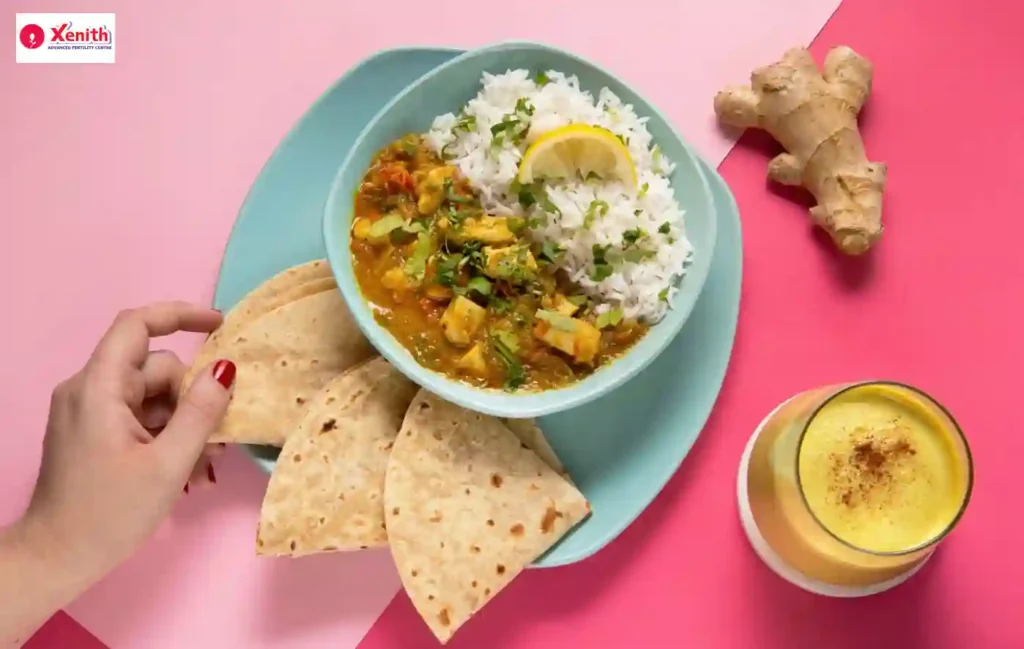
Many patients tell me that understanding nutrition becomes much easier when they can see a practical example of what a day or week of eating might look like.
This meal plan is intended as a general framework rather than a prescription. Please adjust it according to your appetite, digestive comfort, and any specific instructions from your doctor.
| Meal | Monday / Wednesday / Friday | Tuesday / Thursday | Saturday / Sunday |
| Early Morning | Warm water + soaked almonds & walnuts | Jeera water + flaxseeds | Warm water + amla juice |
| Breakfast | Moong dal chilla + curd | Vegetable upma + boiled egg | Ragi dosa + sambar |
| Mid-Morning | Fresh fruit (guava / papaya / pomegranate) | Coconut water | A small bowl of sprouts |
| Lunch | Brown rice + dal + sabzi + salad + curd | Jowar roti + rajma + salad | Khichdi + ghee + curd + pickle |
| Evening Snack | Roasted makhana or chana | Fruit + a small handful of nuts | Poha or whole wheat toast |
| Dinner | Roti + palak paneer + soup | Dal + sabzi + small bowl rice | Moong soup + roti + sabzi |
| Before Bed | Warm milk with haldi (turmeric milk) | Warm milk with ashwagandha (if prescribed) | Warm milk + dates |
This plan is suitable for most patients during stimulation and the two-week wait. If you have PCOS, insulin resistance, or specific dietary restrictions, please speak with us about a personalised plan.
Frequently Asked Questions
Yes. Eggs, chicken, and fish (low-mercury varieties like rohu, catla, or surmai) are excellent protein sources during IVF. I often encourage patients who eat non-vegetarian food to include these as part of a balanced diet. Avoid raw or undercooked meat and high-mercury fish. Red meat is fine in moderation.
This is one of the most common nutrition questions I receive. Pure desi ghee in moderate amounts, about one to two teaspoons per day can be a good source of healthy fats and fat-soluble vitamins. It can certainly be part of a balanced fertility diet. As with everything, moderation is key.
Extremely spicy food can worsen nausea and acidity, which are already common during stimulation. However, mild to moderate spice as part of your regular Indian diet is absolutely fine. If you are experiencing nausea, you may find milder preparations more comfortable.
Green tea contains antioxidants, but it also contains caffeine and EGCG, which in high amounts may interfere with folate absorption. One cup per day is generally considered safe. During IVF, I often suggest herbal options such as ginger tea, fennel tea, or chamomile tea instead.
Reduced appetite is quite common because of hormonal changes and bloating. In these situations, I encourage patients to focus on smaller, more frequent meals rather than trying to eat large portions. Curd rice, moong dal soup, buttermilk, and fruit smoothies can be useful options when appetite is low. Staying hydrated remains important.
This is perhaps the most important question of all. Diet does not guarantee or prevent IVF success. Outcomes depend on many medical factors. However, good nutritional status supports egg quality, medication response, and uterine receptivity. I encourage patients to think of nutrition as one important part of the bigger picture not the only factor, but certainly a valuable one.
Nourishing Your Journey: A Note from Dr. Mamta Dighe
One thing I have learnt from caring for fertility patients is that IVF asks a great deal from both your body and your emotional wellbeing. Choosing to nourish yourself well during treatment is one of the most meaningful ways you can support your health. Not because it guarantees a particular outcome, but because it helps you feel stronger, healthier, and better prepared for the journey ahead.
I encourage my patients to view nutrition not as a set of strict rules, but as an act of self-care. Every balanced meal, every effort to stay hydrated, and every positive choice is a way of supporting yourself during this important phase of life.
If you would like a personalised nutrition discussion as part of your IVF care at Xenith, please speak to me or a member of our team at your next appointment. We are here to support you every step of the way.
| Ready to start or continue your IVF journey? |
| • Book an in-clinic appointment at Wakad or Koregaon Park |
| • Schedule a Video Consultation with Dr. Mamta Dighe |
| • Call us: +91 91307 76776 | Email: info@xenithivf.com |