When I tell a patient that I want to do an antral follicle count, she sometimes looks surprised and asks, “But doctor, isn’t my AMH enough?”
It’s a very reasonable question. AMH has become one of the most commonly discussed fertility tests, but it is not the only way we assess ovarian reserve. An ultrasound can give us another important piece of information: how many small, resting follicles are visible in the ovaries at a particular point in the menstrual cycle.

Free Thursday Consultation
Book Your AppointmentI often see patients arrive with an ultrasound report containing a number they have already interpreted as “good” or “bad.” One patient may be worried because her AFC is 7, while another may be concerned because hers is 18. Neither number can be interpreted properly without understanding the patient’s age, ovarian reserve markers, menstrual history, and the purpose of the assessment.
So, if you’ve recently had an AFC test or have been advised to get one, let me explain what this number actually tells us and what it doesn’t.
What Are Antral Follicles and Why Do We Count Them?
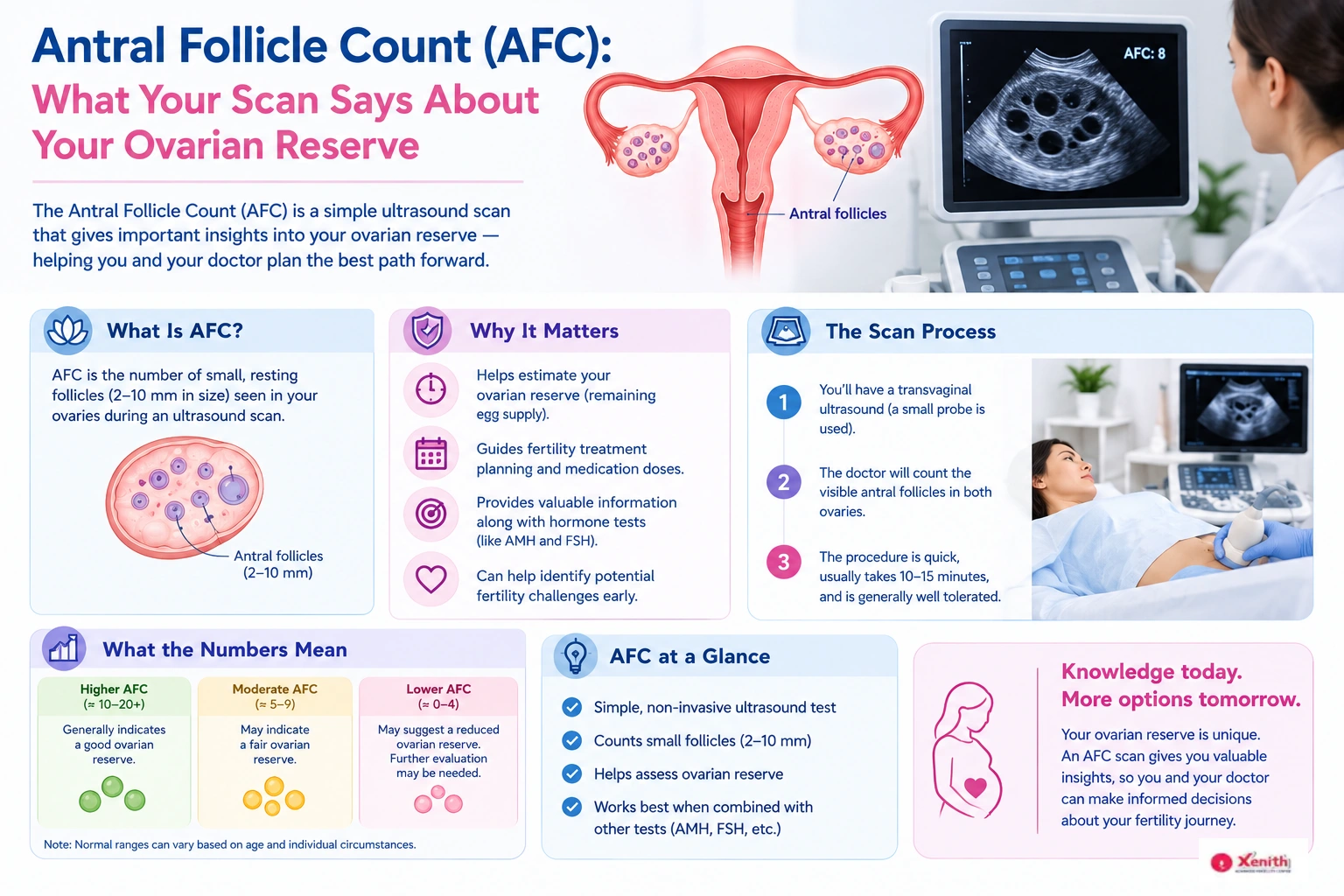
Antral follicles are small fluid-filled follicles that can be seen on an ultrasound scan, usually measuring approximately 2–10 mm during the early part of the menstrual cycle. Each follicle contains an immature egg. We cannot see or count the egg itself on an ultrasound. Instead, we count these visible follicles as an indirect indication of the number of recruitable follicles present in the ovaries. This is called the antral follicle count (AFC).

The count is generally recorded for each ovary and then added together.
For example:
- Right ovary: 6 antral follicles
- Left ovary: 5 antral follicles
- Total AFC: 11
AFC is therefore a measure of ovarian reserve, meaning the remaining quantity of eggs available in the ovaries. But there is an important distinction I make with my patients: ovarian reserve is primarily about quantity, not egg quality. A higher AFC does not automatically mean better-quality eggs, and a lower AFC does not automatically mean pregnancy is impossible.
When Is the AFC Scan Done?
The timing of the scan matters. An AFC is usually assessed during the early follicular phase of the menstrual cycle, commonly around Day 2 to Day 5.
Why? At this point, the ovaries are relatively quiet, and the small antral follicles can be assessed more consistently. Later in the cycle, a dominant follicle develops and other follicles may change in size or visibility. This can make the assessment less standardized.
If you’re having an AFC specifically for fertility assessment or IVF planning, I generally prefer the scan to be performed at the time recommended by your fertility team rather than treating any random ultrasound as an AFC measurement. The quality of the ultrasound equipment and the experience of the person performing the scan also matter. When we’re counting very small follicles, this isn’t simply a matter of pressing a button and reading a number. Careful scanning and consistent technique are important.
What Is a Normal Antral Follicle Count by Age?
One of the most common searches I see is “antral follicle count normal range.”
The difficulty is that there isn’t one universal normal number that applies to every woman. AFC naturally varies between individuals and tends to decline with age. Different studies and laboratories also use somewhat different reference ranges.
The following table is therefore best viewed as a general clinical guide, not a diagnostic cutoff:
| Age | Approximate total AFC often seen | General interpretation |
| 20-24 years | ~15-30+ | Generally higher ovarian reserve |
| 25-29 years | ~12-25+ | Generally reassuring |
| 30-34 years | ~10-20 | Often considered within an expected range |
| 35-39 years | ~6-15 | Increasing variability as ovarian reserve declines |
| 40-44 years | ~3-10 | Lower counts become increasingly common |
| 45+ years | Often <5 | Usually substantially reduced |
These ranges should not be used to diagnose diminished ovarian reserve on their own. There is considerable overlap between women of different ages, and an individual’s AFC can vary between cycles. So if you’re searching for antral follicle count by age, don’t compare your number rigidly with an internet table. For example, an AFC of 8 in a 28-year-old and an AFC of 8 in a 39-year-old may lead us to ask very different questions. I interpret the number in the context of age, AMH, menstrual history, previous ovarian response to stimulation, and your fertility goals.
What Does a Low AFC Mean?
A low antral follicle count suggests that the number of recruitable follicles in the ovaries may be lower than expected. In an IVF cycle, this may mean that we expect fewer follicles to respond to stimulation and potentially fewer eggs to be retrieved.
But there is a statement I repeat frequently in my consultations: A low AFC does not mean you cannot conceive.
This distinction is incredibly important. A woman with a low AFC may still ovulate, have good-quality eggs, conceive naturally, and have a healthy pregnancy. AFC is primarily useful for predicting how the ovaries may respond to fertility medication. It is not a test that can tell you whether you will or will not become pregnant. And it certainly isn’t a test that can tell us exactly how many children you will have.
A Low AFC Does Not Mean You Cannot Conceive
I have had patients become extremely distressed after seeing a low number on their ultrasound report. They sometimes come into my consultation saying, “Doctor, my follicles are low. Does that mean my chances are over?”
I understand why they feel that way, but that’s not what the number means. A low AFC indicates reduced ovarian reserve. It does not mean that there are no eggs left, and it does not tell us that pregnancy cannot happen. Age remains particularly important because egg quality is related much more strongly to age than to AFC itself. A woman with a low AFC may therefore still have a meaningful opportunity for pregnancy, depending on her age and overall reproductive situation.

AFC vs AMH: Why Can the Reports Disagree?
Another common source of anxiety is having an AFC and AMH result that don’t seem to match. For example, a woman may have a low AM but a relatively reassuring AFC. Or the reverse may happen. This doesn’t necessarily mean that one of the tests is wrong.
AMH and AFC measure ovarian reserve in different ways. AMH is a hormone produced by cells surrounding developing follicles and is measured through a blood test. AFC is an ultrasound-based count of visible antral follicles.
Both are useful markers of ovarian reserve, and both can help us estimate how the ovaries may respond to stimulation. However, neither is a perfect measurement of the exact number of eggs remaining.
There can also be variation because of:
- Differences between ultrasound operators
- Ultrasound equipment
- Timing of the scan
- Laboratory variation in AMH testing
- Hormonal medications
- Individual biological variation
So when AFC vs AMH gives apparently conflicting information, I don’t recommend focusing on whichever number looks better or worse. I look at both results alongside the woman’s age, menstrual pattern, medical history, and fertility goals. Sometimes repeating or reassessing the tests is appropriate.
How Is AFC Used to Choose Your IVF Stimulation Protocol?
This is where AFC becomes particularly useful. One of the main reasons we perform an AFC before IVF is to estimate how your ovaries may respond to stimulation. Our goal isn’t simply to produce as many follicles as possible. We want an appropriate ovarian response: enough follicles to give us a reasonable opportunity to retrieve eggs while minimizing excessive response and complications.
Predicting a Poor Response
If the AFC is very low, we may anticipate that the ovaries will recruit fewer follicles during stimulation. This can be described as a risk of poor ovarian response. Knowing this before starting treatment allows us to discuss realistic expectations and choose a stimulation strategy accordingly. It also helps me counsel patients about the possibility that the number of eggs retrieved may be lower than they had hoped.
But even here, I am careful about language. A predicted poor response is not the same thing as saying, “You will not respond.” It is a prediction based on ovarian reserve markers, and actual response can vary.
Predicting Over-Response and OHSS Risk
The opposite situation can also occur. A woman with a high AFC may have many recruitable follicles and can respond strongly to ovarian stimulation. This can increase the risk of ovarian hyperstimulation syndrome (OHSS), particularly in women with conditions such as polycystic ovary syndrome. Knowing that risk in advance allows us to adjust the stimulation protocol and monitoring strategy. Modern IVF protocols give us several ways to reduce the risk of significant OHSS.
So, in this context, AFC is not simply a “fertility score.” It is a planning tool. It helps us decide how cautiously or aggressively to stimulate the ovaries based on the expected response.
Can You Improve Your Antral Follicle Count?
This is another question I hear frequently:
“Doctor, can I increase my AFC naturally?”
Unfortunately, there is no proven treatment that can reliably increase the underlying number of eggs in the ovaries or permanently raise ovarian reserve. The follicles that make up your ovarian reserve cannot simply be created through diet, supplements, or exercise.
You may see products online claiming to “increase AMH” or “increase follicle count,” but I would be very cautious about treating a laboratory number without understanding what it actually represents.
What we can do is optimize the circumstances around fertility treatment. That includes identifying reduced ovarian reserve early, avoiding unnecessary delays when appropriate, selecting an individualized stimulation protocol, and monitoring the ovarian response carefully. In other words, our goal is not to chase a particular AFC number. It is to use the information we have to make the best possible fertility plan for you.
Frequently Asked Questions
What is a good antral follicle count for IVF?
There is no single number that guarantees IVF success. AFC helps predict ovarian response to stimulation. A higher count generally indicates a greater number of recruitable follicles, but egg quality and reproductive outcomes depend on many other factors, especially age.
Is an AFC of 5 low?
An AFC of 5 would generally be considered on the lower side, particularly in a younger woman. However, interpretation depends on age, AMH, ultrasound technique, and the overall fertility picture.
Can a low AFC mean menopause is coming soon?
A low AFC indicates reduced ovarian reserve, but it cannot predict exactly when menopause will occur. It should not be used as a menopause countdown.
Is AFC better than AMH?
Neither test is universally “better.” AFC and AMH provide complementary information about ovarian reserve. When they disagree, the results should be interpreted together rather than choosing one test in isolation.
Does a high AFC mean I have better-quality eggs?
No. AFC primarily reflects follicle quantity. Egg quality is strongly influenced by age and cannot be determined from AFC alone.
What follicle count is needed for IVF?
There is no minimum AFC required to undergo IVF. Even women with a low AFC may proceed with IVF, depending on their individual circumstances and treatment goals.
Can I get pregnant naturally with a low AFC?
Yes. A low AFC does not mean natural pregnancy is impossible. It indicates reduced ovarian reserve, while natural conception also depends on ovulation, egg quality, sperm factors, fallopian tubes, age, and other reproductive factors.
Get Your Ovarian Reserve Assessed at Xenith, Wakad and Koregaon Park
If you’ve recently received an AFC result that has left you confused or worried, please don’t interpret the number in isolation.
When I assess ovarian reserve, I want to know more than just “How many follicles do I see?” I want to understand what that number means for you. Your age, AMH level, menstrual history, previous fertility treatment, ultrasound findings, and pregnancy plans all help us put the AFC into perspective. At Xenith, our fertility team can assess your ovarian reserve and use the findings to guide fertility planning, including deciding whether IVF is appropriate and, when needed, selecting a stimulation approach suited to your expected ovarian response.
If you already have an AFC or AMH report, bring it to your consultation. We can review the numbers together rather than letting an isolated result become a source of unnecessary anxiety.