When a couple comes to me because of a low sperm count, one of the things I always want to know is whether there is an underlying cause that we can actually treat. A varicocele is one such condition.
I have had many men come into my consultation holding a semen analysis in one hand and a Doppler ultrasound report in the other, asking me, “Doctor, do I really need surgery? Can’t we just do IVF?” Others have already been told that their varicocele is “Grade 1” or “Grade 2” and are worried that this automatically means an operation. It doesn’t.

Free Thursday Consultation
Book Your AppointmentA varicocele can affect sperm production and sperm quality, but the decision between varicocelectomy and IVF/ICSI is not based on the ultrasound report alone. We have to look at the severity of the varicocele, semen parameters, sperm DNA quality, the duration of infertility, previous treatment, and very importantly the age and fertility situation of the female partner.
So, if you’ve recently been diagnosed with a varicocele and are wondering whether to treat it surgically or proceed directly to assisted reproduction, let’s go through the decision step by step.
What Is a Varicocele?
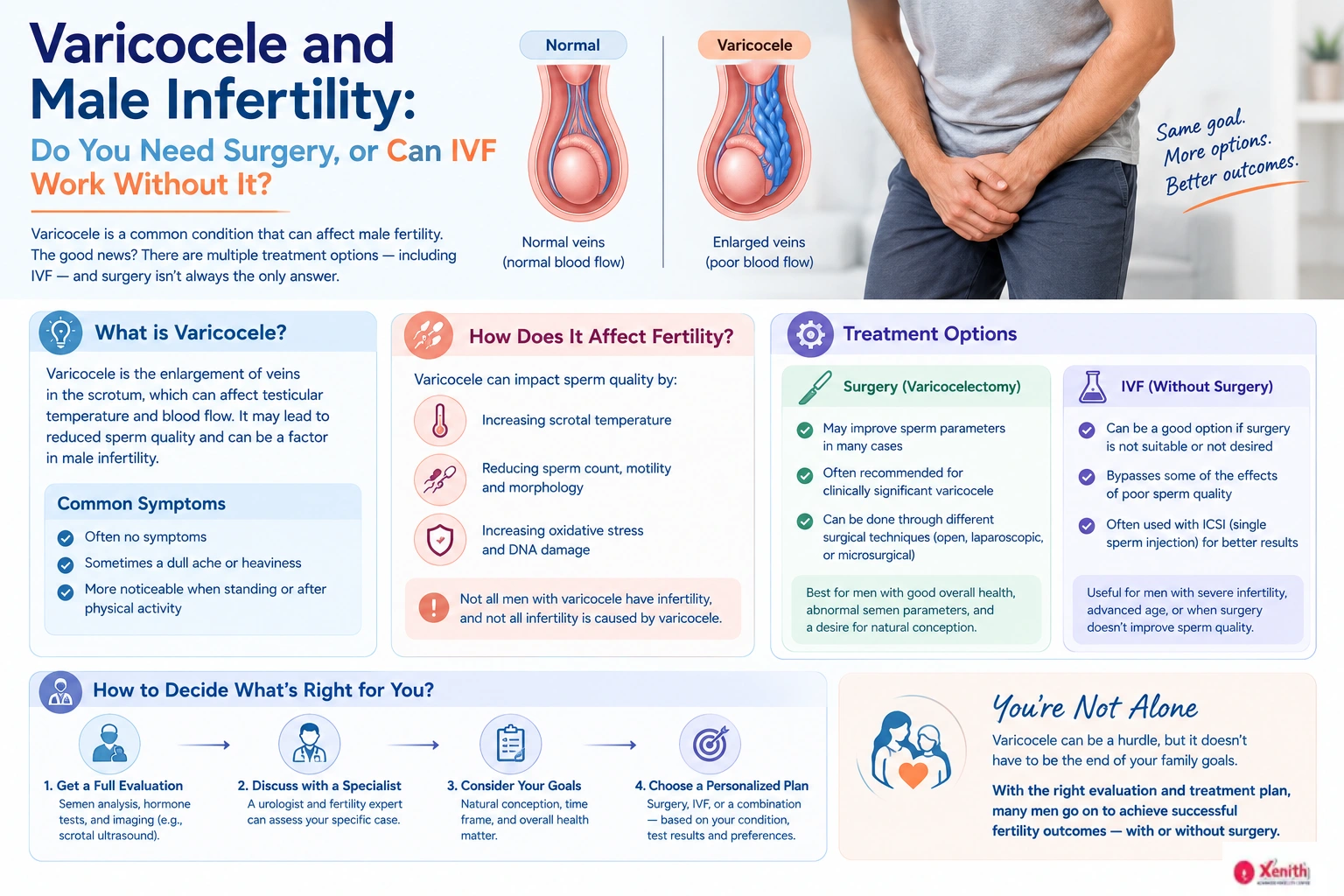
A varicocele is an enlargement of the veins around the testicle. You can think of these veins as part of the body’s drainage system. Normally, blood flows away from the testicles through these veins. When the valves within the veins don’t work efficiently, blood can pool, causing the veins to become enlarged and twisted.

Varicoceles most commonly occur on the left side, although they can occur on either side or both. They are relatively common and are not automatically a cause of infertility. Some men with varicoceles have completely normal semen parameters and have no fertility problems. The concern arises when a clinical varicocele is associated with impaired sperm production or quality.
Current male-infertility guidelines specifically support considering varicocele repair in men who are trying to conceive, have a palpable varicocele, infertility, and abnormal semen parameters. They do not recommend surgery simply for a varicocele that is visible only on imaging but cannot be felt on examination.
Why Can a Varicocele Damage Sperm?
The testicles function best at a temperature slightly below core body temperature. The veins surrounding the testicle normally contribute to a cooling mechanism. When a varicocele develops, this temperature regulation can become less efficient. But temperature is only part of the story.
Varicoceles are also associated with increased oxidative stress. Excess oxidative stress can damage developing sperm cells and affect sperm membranes and DNA. This is one reason why a man can sometimes have a sperm count that doesn’t look dramatically abnormal while still having impaired sperm quality.
Recent evidence also supports an association between varicocele and increased sperm DNA fragmentation. A 2025 systematic review and meta-analysis found significantly higher sperm DNA fragmentation in men with varicocele compared with men without it.
The Link to a High DFI Report
This is where I often see patients become confused. A semen analysis tells us about conventional parameters such as:
- Sperm concentration
- Total sperm count
- Motility
- Progressive motility

- Morphology
A DNA fragmentation index (DFI) looks at something different: the integrity of the genetic material inside the sperm.
If you have a varicocele and a high DFI report, I would not simply look at the DFI number in isolation. I would put it together with your clinical examination, semen analysis, fertility history, and the female partner’s reproductive factors.
There is growing evidence that varicocele repair can reduce sperm DNA fragmentation in appropriately selected men. Meta-analyses have found reductions in sperm DNA fragmentation following varicocelectomy, although the studies vary considerably and improvement in a laboratory measure does not automatically guarantee a pregnancy. That distinction is important.
A lower DFI can be encouraging, but our ultimate goal is not simply to improve a number on a report. It is to improve the couple’s chance of achieving a healthy pregnancy.
Varicocele Grades 1, 2 and 3: What Does Your Report Mean?
Varicoceles are commonly classified into three clinical grades.
| Grade | General description |
| Grade 1 | Small; usually palpable only when bearing down or performing a Valsalva manoeuvre |
| Grade 2 | Palpable without needing to bear down, but usually not visible |
| Grade 3 | Large enough to be visible and palpable |
The grade can help describe the physical severity of the varicocele, but the grade alone does not decide whether you need surgery.
For example, a man with a Grade 1 varicocele and significantly abnormal semen parameters may require more attention than a man with a larger varicocele but completely normal sperm production.
This is why I don’t recommend treatment based simply on seeing “Grade 2” or “Grade 3” on a report. The clinical examination and fertility picture matter.
Symptoms Most Men Never Notice
One reason varicoceles are often discovered during a fertility evaluation is that many men have no symptoms at all.
Some men may experience:
- A dull ache or heaviness in the scrotum
- Discomfort that becomes more noticeable after standing for long periods
- A dragging sensation
- Visible or enlarged veins
- A difference in testicular size in some cases
But many men have none of these symptoms. I have seen patients who felt completely healthy and were surprised when their physical examination revealed a varicocele. That is why absence of pain does not necessarily mean absence of an effect on fertility.
How Is a Varicocele Diagnosed?
The first step is usually a careful physical examination. The scrotum is examined while the patient is standing. A Valsalva manoeuvre might asked, essentially bearing down briefly, to see whether the veins become more prominent.
A Doppler ultrasound can then provide additional information.
It can help us assess:
- The veins around the testicle
- Blood flow
- Venous reflux
- Testicular size
- Whether a varicocele is present when the examination is uncertain
However, an ultrasound finding by itself does not automatically mean that surgery is required. In fact, current AUA/ASRM guidance specifically recommends against varicocelectomy for non-palpable varicoceles found only on imaging.
The Real Question: Varicocelectomy or Straight to IVF/ICSI?
This is where individualized fertility planning becomes particularly important. There is no universal rule saying that every man with a varicocele should have surgery before IVF. Likewise, there is no rule saying that IVF should always be used instead of treating the varicocele.
When Surgery Genuinely Improves the Odds
Varicocelectomy may be worth considering when there is a palpable varicocele, infertility, and abnormal semen parameters. The potential benefit is that we are treating an underlying condition rather than simply bypassing it. If sperm production improves after repair, this may potentially open the door to natural conception or less intensive fertility treatment in some couples.
Guideline evidence supports considering surgical repair in appropriately selected men, and studies have reported improvements in semen parameters and pregnancy rates after treatment of clinical varicoceles. However, the quality of evidence varies, so surgery should still be individualized.
I particularly think carefully about surgery when the man is relatively young, the female partner has good reproductive potential, and there is enough time to wait for sperm production to respond.
When Surgery May Delay Treatment Without Enough Benefit
There are situations where going directly to IVF or ICSI may make more sense.
For example, if sperm production is severely impaired, the couple has already spent considerable time trying to conceive, or there are important female-factor concerns, waiting several months for sperm parameters to improve may not be the best strategy.
The situation is especially different in severe male-factor infertility or non-obstructive azoospermia, where the evidence supporting varicocele repair before assisted reproduction is much less definitive. AUA/ASRM guidance notes that varicocele repair can delay ART by at least six months in these circumstances.
And this brings me to one of the most important factors in the decision.
How the Female Partner’s Age Changes the Decision
Male fertility is only half of the couple’s reproductive picture.
Female fertility declines with age, and female age is a major predictor of reproductive potential. ASRM recommends a more prompt infertility evaluation and treatment approach as female age increases, particularly from age 35 onward.
So, imagine two couples with identical varicocele findings. For one couple, the female partner may be 28, ovarian reserve may be reassuring, and there may be plenty of time to consider varicocelectomy and reassess the semen analysis after recovery. For another couple, the female partner may be 38, ovarian reserve may be reduced, and the couple may already have been trying for several years.
I would not necessarily recommend the same treatment strategy to both. In the second situation, delaying IVF for several months simply to see whether sperm parameters improve after surgery may carry a meaningful opportunity cost. This is why I always evaluate the couple, not just the man’s varicocele.
What Happens After Varicocelectomy?
Patients often expect the sperm count to improve within a few weeks. That’s usually not realistic. Sperm production takes time, so improvements are generally assessed over several months. Depending on the individual case, semen parameters may be reassessed at around 3 and 6 months after surgery.
Evidence suggests that sperm DNA fragmentation may also improve over this period. A recent meta-analysis found reductions in SDF at both three and six months following varicocelectomy. But I always explain that these are timelines, not guarantees. Some men experience a meaningful improvement in sperm concentration, motility, morphology, or DNA integrity. Others see only a modest change, or no clinically useful improvement.
That is why the decision to operate should be made before surgery, based on the likelihood that treating the varicocele will meaningfully change the couple’s fertility plan.
Frequently Asked Questions
Does every varicocele cause infertility?
No. Many men with varicocele remain fertile and have normal semen parameters. The concern is greatest when a clinically palpable varicocele is accompanied by infertility and abnormal semen parameters.
Is Grade 3 varicocele always treated with surgery?
No. Grade 3 indicates a larger clinically apparent varicocele, but the decision for treatment depends on fertility status, semen parameters, symptoms, testicular findings, and the couple’s reproductive goals.
Can IVF work if I have a varicocele?
Yes. The presence of a varicocele does not automatically prevent IVF or ICSI from working. The question is whether treating the varicocele first is likely to improve the overall treatment strategy or whether proceeding directly to assisted reproduction is more appropriate.
Can varicocele treatment improve sperm count?
It can. In appropriately selected men, varicocelectomy may improve semen parameters, although the degree of improvement varies between individuals.
Does a high DFI mean I definitely need varicocele surgery?
Not necessarily. A high DFI can be an important part of the evaluation, particularly when a clinical varicocele is present, but the decision about surgery should consider the complete fertility picture. Evidence suggests DFI may improve after repair, but DFI alone should not determine treatment.
How long should I wait after varicocelectomy before reassessing sperm?
Typically, we think in terms of months rather than weeks. Semen analysis is often reassessed around 3–6 months, depending on the individual situation and the reason for treatment.
Where can I get varicocele treatment in Pune?
If you’re looking for varicocele treatment in Pune, I would recommend choosing a centre where the male infertility evaluation and reproductive treatment planning are considered together. The important question is not simply “Can the varicocele be operated on?” but “Will treating it improve this couple’s chance of pregnancy, and is waiting for that improvement worthwhile?”
Talk to Xenith’s Male Infertility Subspecialty Clinic
When I meet a man with a varicocele, I don’t want to make the decision based on a single number, ultrasound image, or grade. I want to understand the complete picture: the semen analysis, sperm DNA quality when indicated, physical examination, duration of infertility, previous fertility treatment, and the female partner’s age and reproductive health.
Sometimes, the best decision is varicocelectomy followed by a period of observation. Sometimes, proceeding directly to IVF/ICSI is more appropriate. And sometimes, no treatment for the varicocele is needed at all.
That is why I encourage couples not to think of varicocelectomy vs IVF as two competing treatments. They are different tools, and the right choice depends on what we are trying to achieve for your particular family.
At Xenith’s Male Infertility Subspecialty Clinic, we can evaluate the varicocele alongside the couple’s overall fertility picture and discuss whether surgery, assisted reproduction, or a combination of approaches makes the most sense.If you already have a semen analysis, Doppler report, or DFI report, bringing those reports to your consultation is a useful first step. It allows us to move beyond the label of “varicocele” and focus on the question that matters most: what approach gives you the best chance of becoming a parent without unnecessary delay?